
Phonics Magic · Mapping
Count sounds, not letters


The wooden board has five slots for tiles. The mapping board has four boxes for sounds. The counts don't always match, and that is the whole lesson.
An illustrated example
fish
Four letters. Three sounds. The last box stays empty.
The demonstration video is not available yet. Follow the written steps below.
The demo video isn't ready yet. The steps below walk you through it with the board in your hand.
Two boards, two jobs
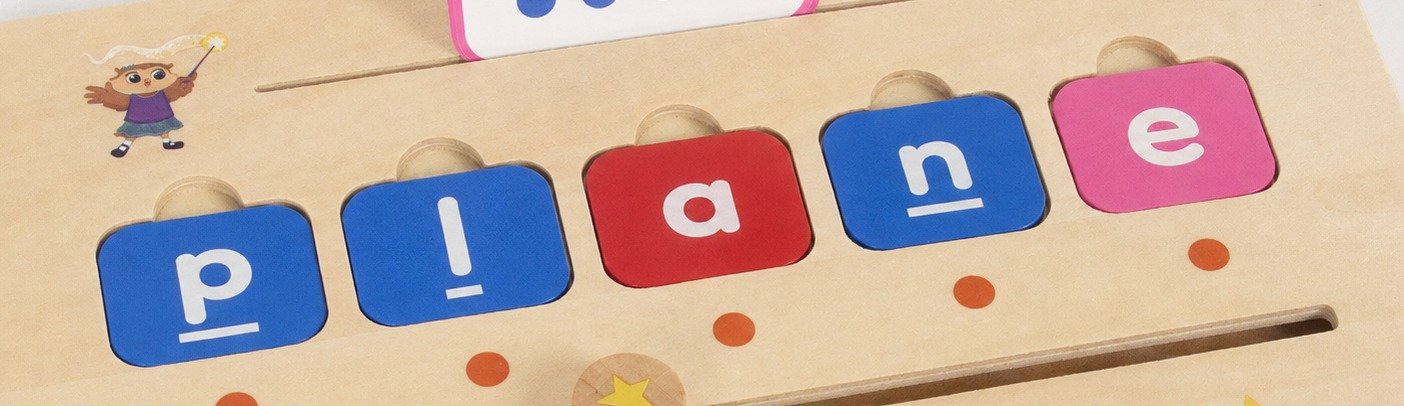
Slots hold tiles.
The wooden board's five slots hold spellings: single letters and letter teams.
Boxes hold sounds.
The mapping board has four boxes for what you hear. fish has four letters and three sounds: f, i, sh.
Your routine, three moves
Say it.
Say the word slowly.
Tap it.
Tap one box for each sound, left to right.
Write it.
Write each sound's spelling in its box, then the whole word on the line. Spare boxes stay empty.
Try these four
Open a word to see its boxes.
fish3 sounds
sh spells one sound, so both letters go in one box.
ship3 sounds
The fourth box stays empty.
snack4 sounds
A blend such as sn has two sounds, so s and n need separate boxes. ck shares one.
plane4 sounds
The pink e is silent. Write a_e together in the /ā/ box. The underline marks where n goes in the whole word. The e never gets its own sound box.
Five sounds, four boxes?
blend, print and splash each have five sounds. Don't squeeze two sounds into one box. Say the sounds and count on your fingers, then write the word on the board's lines. Or draw five sound boxes on paper.
Six letters, five sounds. Keep sh together.
Flip the board: syllable mapping
bath + tub = bathtub
Start with bath from the cards and tub built with tiles. When both are familiar, say bathtub together and clap its two syllables, or beats.
Write one syllable in each box, then the whole word on the line. Use this side for syllables, not individual sounds. You can do the writing.
A tile isn't always one sound
qu in quack spells /k/ /w/: one tile, two sounds. Sound boxes count what you hear, even when the letters on a tile group together.
For educators: phoneme-grapheme mapping. Keep ordinary letter order on the writing line.
Want to hear the sounds you're mapping?
Every sound in the kit, said short and clean.
Every sound in your kitWritten sound cues are ready. Recordings are not available yet.