Reading Help · Where to start · 6 minute read
Where should my child be with reading?

There are eight stages of learning to read.
Children move through these stages at different rates, and that's normal. The right place for your child is the stage that comes next for them, not a stage set by their age. Below is each one in plain words, with one thing to try at each, and a quick check to find where your child is now.
"Where should my child be with reading?" It's one of the first questions parents ask, usually right after school sends home words like CVC, blending and sight words with no explanation of how they fit together. The stages overlap, and schools may teach them in a slightly different order.
What are the stages of learning to read?
First come hearing sounds and letter sounds, then putting sounds together and pulling them apart. After that: reading books, two-letter sounds like sh, blends like st, and vowel patterns like silent e. Many phonics programs teach them in roughly this order. Your child can work on more than one stage at a time, and stages 3 and 4 usually grow together.
-
Hearing sounds in words
Before letters, children learn that words are made of sounds. They notice rhymes (cat, hat), hear the first sound in a word and clap the syllables in their name. Teachers call this phonological awareness.
Try this: play I spy with sounds. "I spy something that starts with /sss/."
-
Learning letter sounds
Letters represent the sounds in spoken words: m says /mmm/ and t says /t/. For reading, the sound matters more than the letter's name.
Try this: one or two new sounds a week, said short and clean. Here's how to say each sound.
-
Putting sounds together
Reading a short word by joining its sounds: /k/ /a/ /t/, cat. This is called blending, and three-letter words like cat are called CVC words (consonant, vowel, consonant). Many children stay here for a while, and that's normal.
Try this: build a word, tap each sound, then slide your finger under it and say it faster. Here's the full routine.
-
Pulling sounds apart
The reverse of blending: hearing "map" and finding /m/ /a/ /p/ to spell it. Teachers call this segmenting. Blending usually comes first, and then the two grow together.
Try this: say a word slowly and ask your child to find the letter for each sound.
-
Reading sentences and books
Reading "The cat sat on a mat" in short books made mostly of words your child can sound out. These are called decodable books.
Try this: ask your library for decodable books that use the sounds your child already knows.
-
Two letters, one sound
sh, ch, th and ck, as in ship, chip, thin and duck. Teachers call these digraphs, and many kindergartens start them soon after three-letter words.
Try this: hunt for sh in a picture book. "Can you find a word with /sh/?"
-
Consonant blends
Two or three consonants side by side that each keep their own sound, like the st in stop and the fr in frog. Teachers call these blends. Some schools teach blends before two-letter sounds like sh; the order varies by program.
Try this: stretch it out, /s/ /t/ /o/ /p/, then say it faster.
-
More vowel patterns
A final silent e (some teachers call it magic e) often changes a vowel from its short sound to its long sound, as in cap and cape. Vowel teams are two vowels working together, like the ee in feet and the ai in rain.
Try this: add an e and read both words. Cap, cape. Hop, hope.
What comes after CVC words?
Short books your child can sound out, then two letters that make one sound (sh, ch), then blends like st, then vowel patterns like cape and rain. Those are stages 5 to 8 above. After stage 8 come longer words and smoother reading, which is when first chapter books start to feel possible.
Along the way, children also learn common words that turn up everywhere, like the, said and was. Schools often call them sight words or high-frequency words. Most can be partly sounded out, so they sit alongside the stages rather than replacing them.
How do I know what reading level my child is at?
Find the first stage your child can't do yet. That's their next step, and a quick check at the kitchen table will show you. It's a game, not a test.
- Ask for the first sound in "sun". If they say /sss/, stage 1 is in place.
- Show them the letter m. If they say /mmm/, stage 2 is under way.
- Build c-a-t with letters. If they can tap the sounds and blend them into "cat", stage 3 is under way.
- Say "map" and ask them to find the letters. If they can, stage 4 is under way too.
For a guided version, try Where's My Reader?, a few questions that suggest a place to start.
How long does it take to teach a child to read?
It varies a lot from child to child, and that's fine. Some children blend within a few weeks of knowing their sounds; others take months. Ten minutes of practice a few times a week, with you next to them, keeps things moving. If you're unsure how your child is doing, their teacher can tell you which stage the class is working on.
The stages in action, from a reading specialist
Jill walks through the order with one word. The picture, then the letters, their sounds, and blending them into mop.
The video plays from TikTok, whose privacy policy applies. Watch on TikTok
Find a place to start
A reading activity for your next session
Answer a few questions about what your child enjoys doing now. See a suggested activity before any email request.
Find an activity to tryNo email needed for the quiz or your result.
The product for this stage
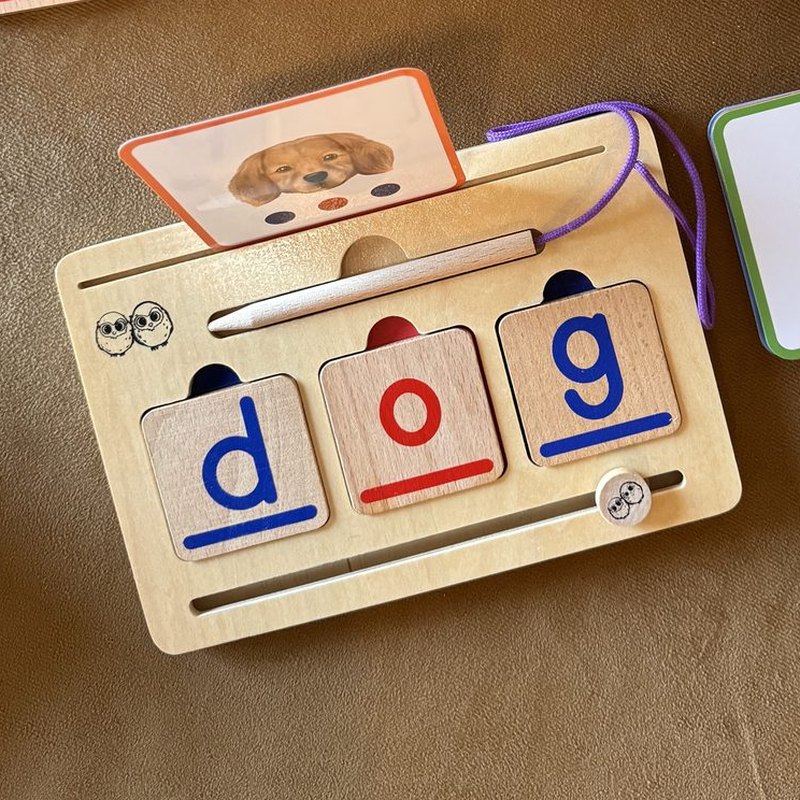
For: stages 3 and 4, reading and spelling three-letter words, once your child knows a few letter sounds
CVC Word Magic
CVC Word Magic covers stages 3 and 4. Build a word with the color-coded tiles, tap each sound, slide to blend it, then flip the tiles to trace the letters. It isn't meant for stage 1, and it stops at three-letter words.
If the sounds in a word are unfamiliar, practice those together first. The reading check can suggest a place to start.
Questions parents ask
Is it normal for a 5-year-old not to read yet?
Yes. Many 5-year-olds are still learning letter sounds or how to blend them. Lots of schools work on both in kindergarten, and plenty of children start earlier or later. Follow your child's stage, not the calendar.
What does CVC mean?
Consonant, vowel, consonant. It means three-letter words like cat, sun and map, with a short vowel sound in the middle.
Sight words or phonics first?
Both, side by side. Your child can learn common words like the and said alongside sounding out. Most of them can be partly sounded out, and the letter sounds help with those parts too.
When should I worry about my child not reading?
Any time something feels off, talk to your child's teacher or pediatrician. You don't need to wait. They can tell you which stage the class is on and how your child is doing. This guide is a map for practice at home, so it can't tell you whether your child is behind.
When do kids learn to read and write?
At the same time. From stage 3 onward, writing the words your child reads helps reading and spelling grow together.
Reviewed by Jill Santos
Jill Santos
M.Ed., Reading Specialist